
The Selamlık and the Harem
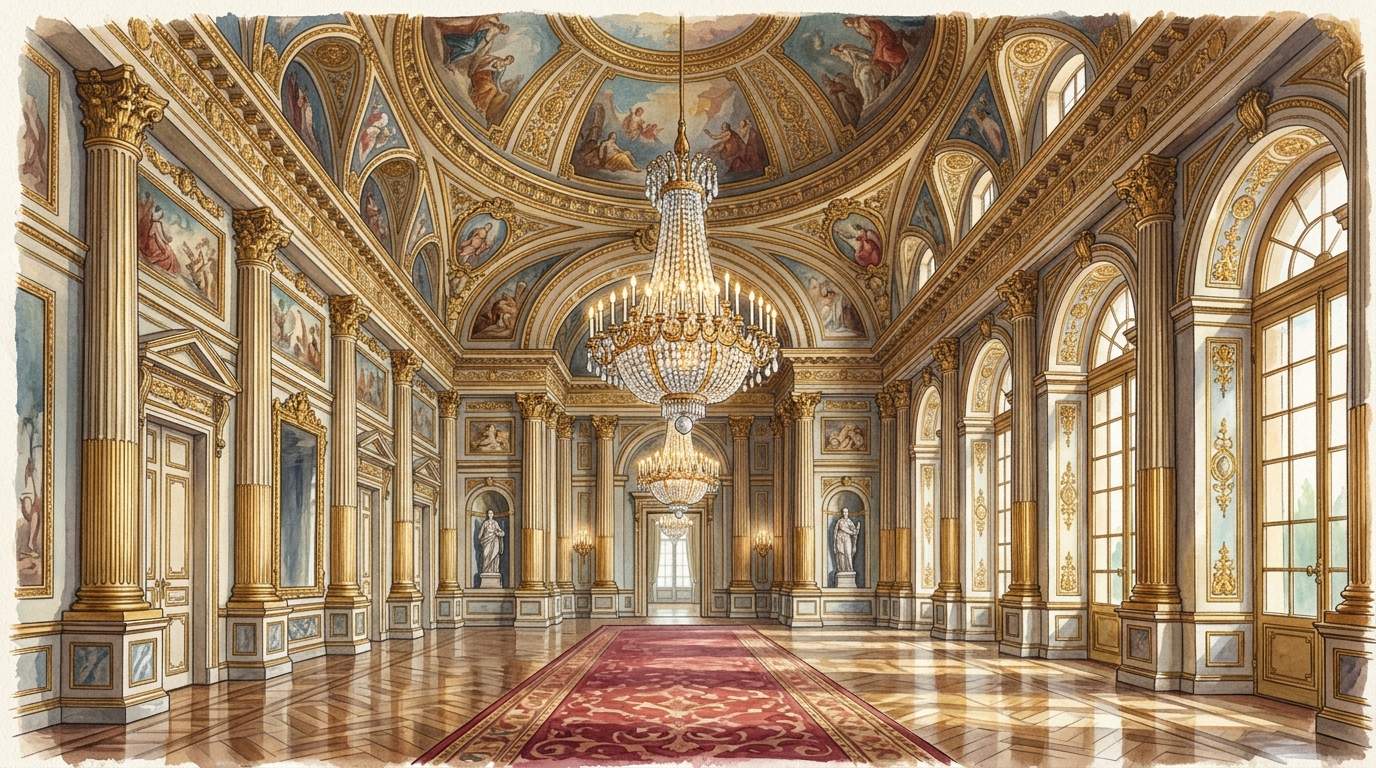
Dolmabahce Palace is really two palaces under one roof: the Selamlık, the vast ceremonial wing where the empire performed itself for the world, and the Harem, the private half where the sultan’s family actually lived — and one combined entry now covers both. Knowing what each half is for transforms the visit: the Selamlık is spectacle, the Harem is biography, and the palace only makes full sense once you have walked the two in order.
One Building, Two Worlds
The split was not an architectural whim but Ottoman social law. Every grand Ottoman house divided formal male-facing space (selamlık) from family space (harem), and Dolmabahçe scaled that domestic rule up to imperial size. The Balyan architects wrapped both worlds in one continuous European-style shell — from the water you would never guess the divide — but inside, the two halves were run, staffed and furnished as separate realms, hinged together by the Ceremonial Hall at the building’s centre.
That geography survives in today’s visitor route: you tour the Selamlık’s state rooms first, pass through or around the great hall, then continue into the Harem. Allow roughly an hour for the first half and 45 minutes for the second.
The Selamlık: The Empire On Stage
The Selamlık is what the postcards mean by “Dolmabahçe”: the Medhal entrance hall, the Crystal Staircase rising in a double horseshoe, the Ambassadors’ Hall where foreign envoys were received under acres of gold leaf, and salon after salon of Bohemian crystal, Hereke carpets and painted ceilings. Everything is calibrated to communicate one message — that the 19th-century Ottoman state belonged in the same room as Paris, Vienna and St Petersburg.
It crescendos in the Ceremonial Hall, the domed centrepiece where the 4.5-tonne chandelier hangs — a room built for coronation-scale ritual, and still used for state occasions today. Our inside-the-palace overview walks the highlights room by room.
Expect the Selamlık to be the busier half. Groups sweep through it on schedules, and the corridors meter the flow; an early start (the palace opens at 09:00, closed Mondays) is the difference between walking the staircase and queueing on it.
The Harem: The Family Behind the Curtain
Cross into the Harem and the volume drops — literally and figuratively. Ceilings lower, gilding thins, carpets soften underfoot. These were the apartments of the sultan, his mother (the valide sultan, the Harem’s real authority), his consorts and children: bedrooms, sitting rooms, school rooms and baths arranged around corridors that were once the most restricted address in the empire.
Highlights worth slowing down for:
- The Blue Hall and Pink Hall — the Harem’s own reception rooms, where the imperial family gathered for religious festivals.
- The valide sultan’s apartments — the suite that governed the household.
- Atatürk’s room — the bedroom where the Republic’s founder spent his final illness and died at 9:05 on 10 November 1938. The flag-draped bed and the stopped clock make it the most quietly affecting space in the palace.
The Harem is not a lesser Selamlık; it is the answer to the question the state rooms raise — who actually lived like this? The honest reply, visible in these plainer corridors: people who kept the theatre out front and something more human in the back.
Practical Notes for Both Halves
- One entry covers everything. The old separate-section arrangement is gone; a single combined admission now includes Selamlık, Harem and the palace collections, with an audio guide handed to you at the start. The section-by-section detail of what admission covers is kept current on our partner’s palace entry page.
- No interior photography in either half — the ban is enforced throughout, which is partly why the photo gallery leans on exteriors.
- Budget two hours for both halves at an unhurried pace; the plan-your-visit page fits those hours into a morning.
Walked in the right order — spectacle first, family second, waterfront terrace to finish — the two halves of Dolmabahçe add up to the fullest portrait anywhere of how the Ottoman story ended: in a palace half built for the world’s eyes, and half for its own.