
Inside Dolmabahce Palace
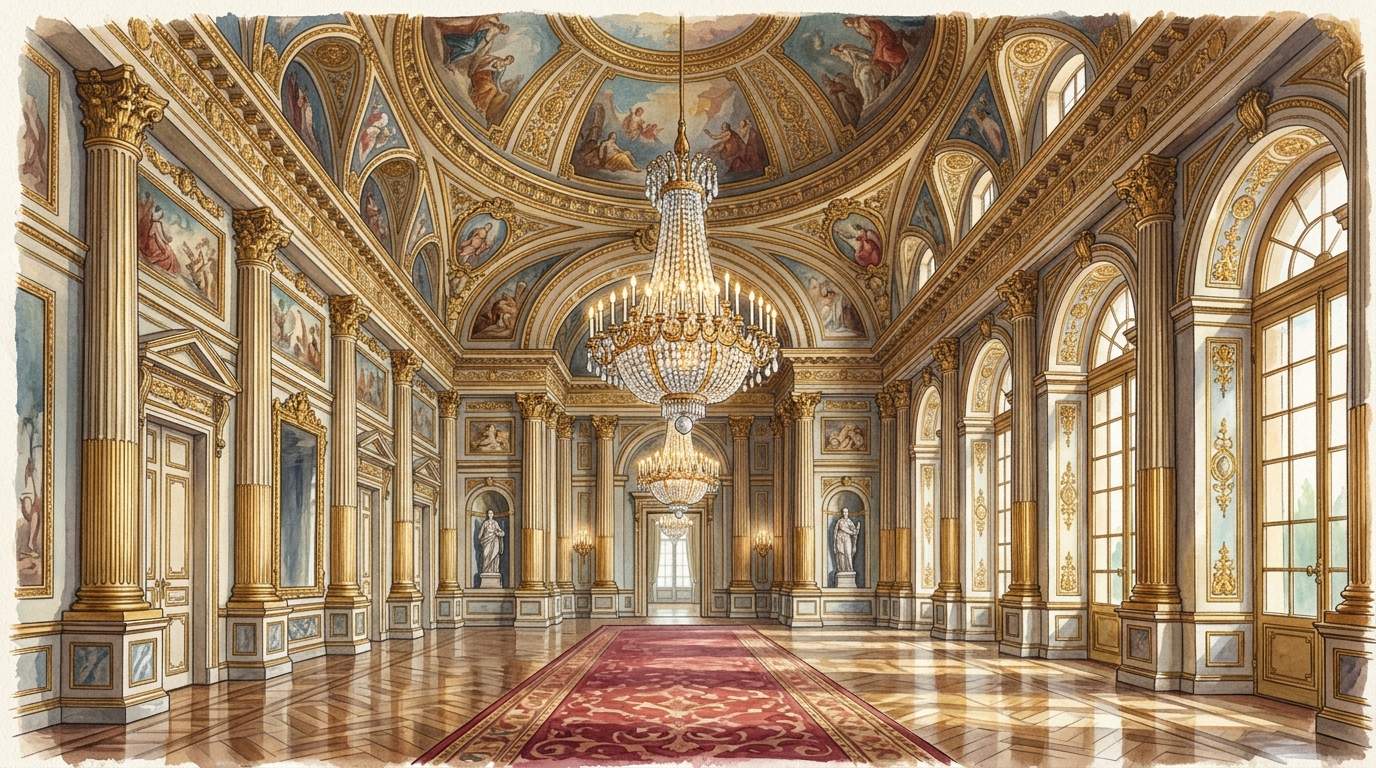
Inside, Dolmabahce Palace is a procession: entrance hall, crystal-balustraded staircase, a chain of ever-grander state salons, the colossal domed Ceremonial Hall, and then the quieter private rooms of the Harem — all walked in one continuous, sign-posted route of about two hours. You cannot wander freely as in some museums; the palace channels everyone along the same path the empire once choreographed for its guests, which happens to be the best way to see it.
This page follows the route stop by stop — which rooms are coming, what each was for, and where the unmissable moments land. Photography is not permitted in the interiors, so what follows is also, in effect, the picture the camera will not take.
The Medhal Hall: The Overture
The route begins in the Medhal (entrance) Hall, and the palace shows its hand immediately: a two-storey salon of columns, gilt and a Bohemian crystal chandelier that would headline most buildings, functioning here as a mere lobby. Officials once graded visitors in this room — who proceeded upstairs, who waited. Take a moment on the threshold; the palace’s whole rhetorical strategy, overwhelm-by-anteroom, is on display before you have gone ten steps.
The Crystal Staircase
From the Medhal you reach the palace’s signature flourish: a double-horseshoe staircase whose balusters are shafts of Baccarat crystal, rising under a glass skylight that fills the well with Bosphorus light. It was engineered to stop ambassadors mid-step, and it still works on everyone. The full story of the palace’s crystal obsession — this staircase and the chandeliers it rehearses for — belongs to our sister guide’s page on the chandelier and Crystal Staircase; on the route itself, simply climb slowly.
The State Salons: Power as Interior Design
Upstairs, the Selamlık unrolls as a sequence of reception rooms, each tuned to a different register of power:
- The Ambassadors’ Hall (Süfera Salonu) — the largest and most gilded of the salons, where foreign envoys absorbed the message that the empire could out-splendour Europe. Note the Hereke carpets, woven to the room’s own dimensions.
- The Red Room — audience chamber for heads of state, upholstered in the crimson of imperial authority.
- The Zülvecheyn Hall — the “two-faced” salon looking to both land and sea, the pivot between the palace’s public and private geographies.
- The Sultan’s hamam — a bathing suite in translucent Egyptian alabaster, plumbing as a status statement.
The audio guide provided with entry gives each room its minute of context; between rooms, keep an eye on the ceilings — very little of what reads as carved stone is stone, and the painters’ trompe-l’œil is half the fun once you catch it.
The Ceremonial Hall: The Crescendo
Every corridor has been leading here. The Muayede (Ceremonial) Hall occupies the centre of the palace at double height, its dome painted sky-high above a floor built for enthronement ceremonies, religious festivals and — since the Republic — state funerals and receptions. Overhead hangs the celebrated 4.5-tonne chandelier, the largest object in a palace that collects superlatives. Fifty-six columns, a dome fresco pretending to be architecture, and space for several thousand people: it is the single room that justifies the visit on its own.
Into the Harem
Beyond the great hall, the route crosses into the Harem, and the palace changes voice — smaller rooms, softer decoration, actual furniture that looks used. The highlights are covered in depth on our Selamlık and Harem page: the Blue and Pink Halls, the valide sultan’s apartments, and the room where Atatürk died, its clock stopped at 9:05. As a rule of thumb, the Selamlık shows you what the dynasty wanted seen; the Harem shows you what it was.
Seeing the Interior Well
Three practical notes make the difference inside:
- Go early. The salons meter visitors through fixed corridors, and a 09:00 start (the palace opens Tuesday–Sunday) means empty rooms instead of shuffling queues.
- Give it two hours. An hour for the Selamlık, 45 minutes for the Harem, and slack for the staircase moment. Rushing the second half is the classic mistake.
- Sort entry before you arrive. Interior capacity is capped daily; arranging admission in advance protects the early slot that makes all of the above work.
When you step back out onto the waterfront terrace, look up at the façade once more — the photo gallery shows the views worth collecting outside, while the visit-planning page fits the rest of the day around them.